
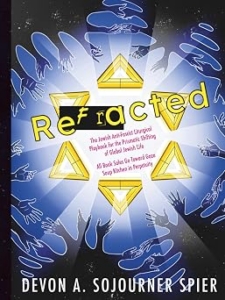
The prayer-poems / art pieces / aphorisms in Devon Spier’s new book Refracted remind me of Jenny Holzer’s Truisms, if Truisms had been created to spark prayer, theological insight, and action in the world rather than to narrate, discomfit, and provoke.
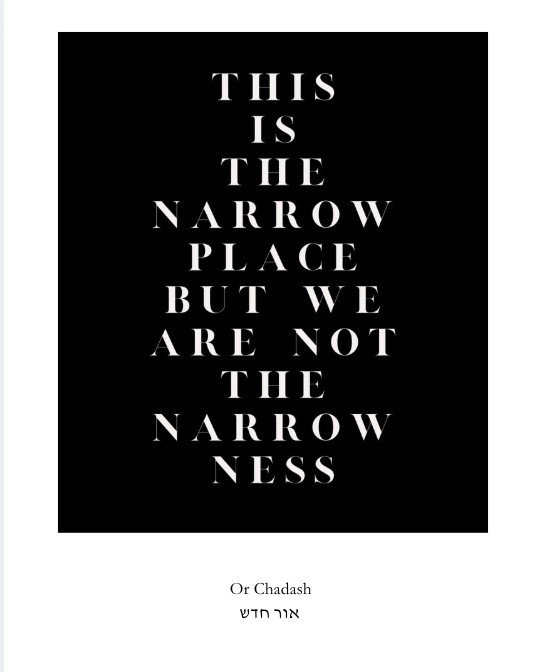
Devon is a member of Bayit’s Liturgical Arts Working Group, and this new volume showcases one of her approaches to prayer. Devon describes the book as her attempt “to create Jewish anti-fascist prompt liturgy that redeems Zion from Kahanism and pulls us out of collective and Jewish numbness in time of global authoritarian dominance and indifference-making prayer rhythms.”
Refracted moves through the rhythm of the siddur (weekday and Shabbat prayerbook). Each page features a short poem or aphorism or series of instructions presented starkly in black and white, and at the bottom, like a hatimah (seal), the title of (or a phrase from) a prayer.
As she writes in the introduction,
The contents of this book are death and truth, vitality and decay. They provide a set of incanting acts before, and during, and after Jewish weekday and Shabbat prayers. And yet, they can readily be used anywhere in the world, at any point of time, in the rhythm of your own heartbeats.
For a reader / pray-er who knows the daily or weekly liturgy, the book takes a recognizable path through classical liturgy. The short prayer titles / Hebrew phrases on each page string together like pearls, and together they create a necklace of praise, grief, and hope, for the pray-er or for Shekhinah. That said, if you don’t live in Jewish liturgical rhythms I think the book will still be meaningful, though each page might feel more like its own art piece than part of a flow.
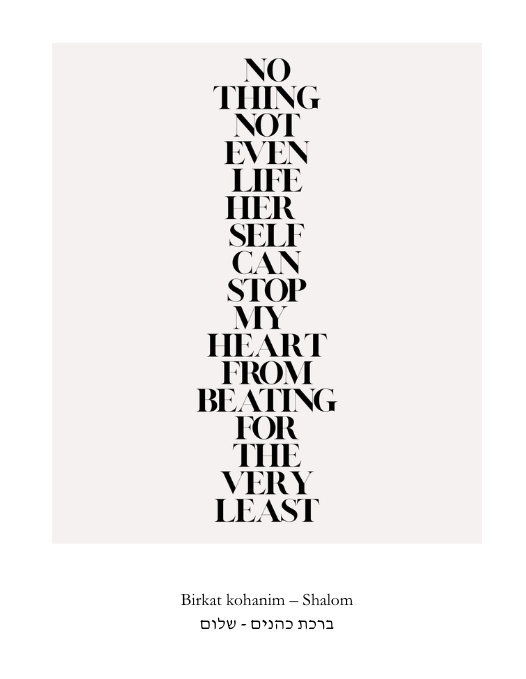
I’m particularly moved by Devon’s approach to the psalms for each weekday. In her Psalm for Tuesday, she writes, “seems / to / me / you / only / know / your / heart // the / moment / it / and / you / are / breaking[.]” The two-page spread for the psalms of Wednesday and Thursday features parallel boxes, one light grey and the other black, the text upon them reading simply, “I despair[.]” (Relatable.)
But then the Psalm for Friday lifts us back up: “I despair / because / I / hope[.]” These four tiny and deceptively simple lines capture something important: sometimes our despair is sharper because we dared to hope the world could be better… and the coming of Shabbat can offer our souls the uplift we need to shift from despair to renewed hope once again.
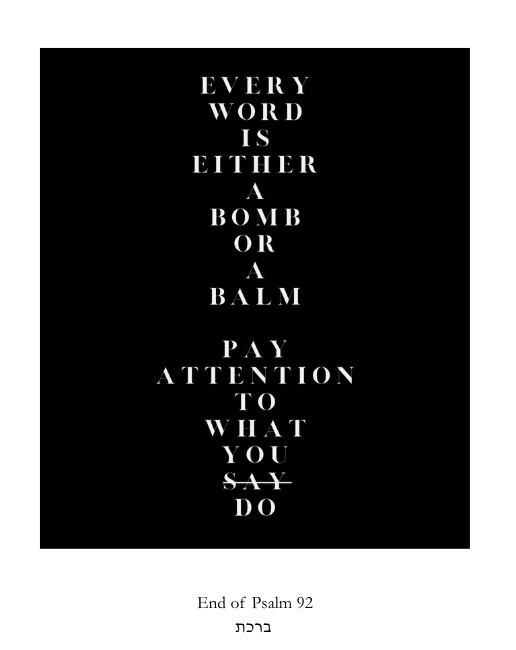
These are prayers that ask us not just to pray, but to think about and improve who we are in the world. Her Psalm 92, for instance, the psalm for Shabbat, teaches:
The subtitle of the book is “The Jewish Anti-Fascist Liturgical Playbook for the Prismatic Shifting of Global Jewish Life.”
That’s a few bold claims in one. “The” does a lot of work; I would have gone with “A.” And “Shifting of Global Jewish Life” is a pretty hutzpahdik intention. That said, the future-oriented optimism and the playfulness with language (e.g. “playbook” instead of “prayerbook”) remind me of Reb Zalman z”l. And I could use a little optimistic hutzpah these days.
Just beneath the subtitle, the cover notes that “all book sales go toward Gaza Soup Kitchen in perpetuity.” That intention may be enough to keep some folks from buying this book. I hope not, though, for a couple of reasons. One, I appreciate that Devon is walking her talk. And two, feeding the hungry is a very Jewish thing to do.
tl;dr this is a prayerbook I’m grateful to own. Get your own copy here.

R. Rachel Barenblat is a founding builder at Bayit and the convener of the Liturgical Arts Working Group.

