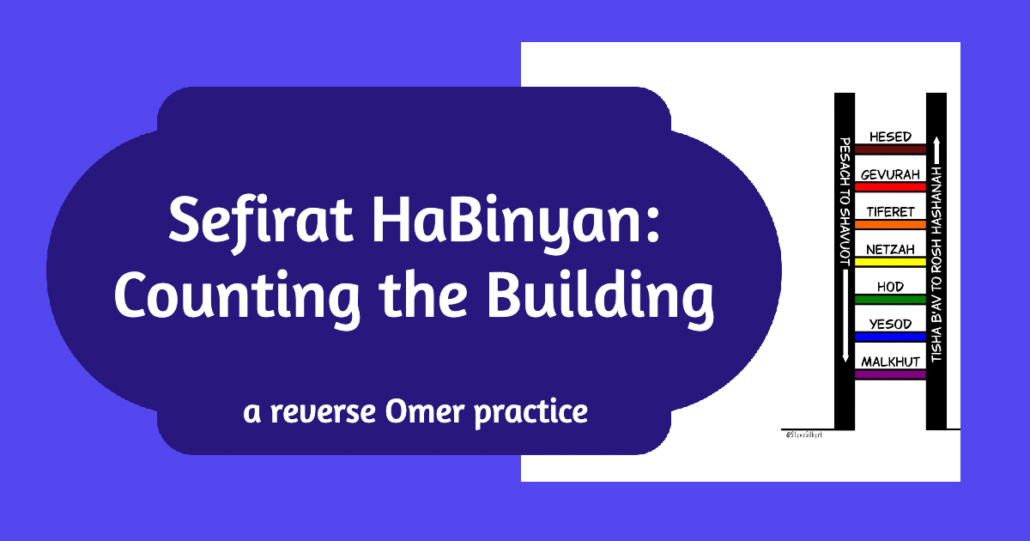
Sefirat HaBinyan: Counting the Building
If you prefer to read this essay as a downloadable PDF, it’s available in that format here: Sefirat_HaBinyan_Framework_Nerlinger.
I. Two Corridors of Sacred Time
The Jewish year is structured around sacred time in ways that most practitioners only partially inhabit. We are familiar with the spring corridor—the forty-nine days of the Omer between Pesaḥ and Shavuot, in which we count upward from liberation to revelation, from Ḥesed through the seven sefirot to Malkhut, preparing ourselves to receive Torah. This corridor is ancient, liturgically rich, and in recent decades has been revitalized through the kabbalistic practice of daily sefirot reflection.
What is less known—though it is equally present in the structure of the Jewish year—is the existence of a parallel forty-nine-day practice within the summer and early- fall corridor between Tisha B’Av and Rosh Hashanah. These are not forty-nine empty days on the calendar. They are the seven weeks of consolation, the Shiva d’Neḥemta, marked by seven haftarot from the book of Isaiah read on the seven Shabbatot between the ninth of Av and the new year. They are a period of deliberate preparation for the yamim noraim, the Days of Awe. And, as Rabbi Zalman Schachter-Shalomi z”l recognized, they are the natural home of a reverse sefirot practice—ascending not from Ḥesed to Malkhut, as in the Omer, but from Malkhut back to Ḥesed, from the broken embodied grief of Tisha B’Av to the expansive love with which we are meant to greet the new year.
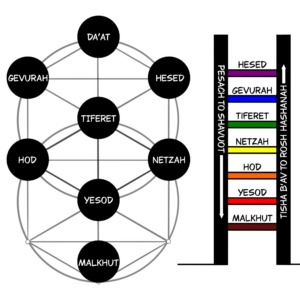
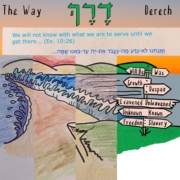
Illustration by Steve Silbert.
This practice, which Reb Zalman called Sefirat HaBinyan—Counting the Building—remains one of the least developed and least known of his innovations. It exists primarily in oral transmission, in scattered blog posts and second-hand accounts, in the memories of those who took classes with him. It has never been given a full theological treatment, a complete week-by-week framework, or a set of daily reflections comparable to what exists for the spring Omer count.
This document is an attempt to begin that work. It draws on Reb Zalman’s published writings, his recorded teachings, the testimony of those who studied with him, and the rich liturgical tradition of the seven weeks of consolation. Its goal is to lay a theological and methodological foundation sufficient to support the development of daily reflections for all forty-nine days of Sefirat HaBinyan—reflections grounded in the same kabbalistic framework as the spring Omer practice, but oriented toward the distinct spiritual work of teshuvah, consolation, and renewal.
II. Reb Zalman’s Teaching: What We Know and How We Know It
The origin of Sefirat HaBinyan as a formal practice is, as Rabbi Rachel Barenblat has honestly acknowledged, “the rebbe said.” Reb Zalman taught this practice primarily in oral form, in summer retreats and classroom settings, in the years when he held the World Wisdom Chair at Naropa University in Boulder. The primary written account comes from a 2008 blog post on JewishRenewalHasidus.org, where Gabbai Seth Fishman—who took classes with Reb Zalman during this period—recounts the practice and includes fragments of Reb Zalman’s own rationale. Rabbi Aubrey Glazer, in an article titled “Transforming Loss into Love: Counting the Omer in Reverse,” provides a week-by-week framework with practical themes. And Rabbi Barenblat has written about the practice with theological sensitivity in multiple blog posts at Velveteen Rabbi.
What is striking, when one surveys these secondary sources alongside Reb Zalman’s published works, is how clearly the practice emerges from—and is illuminated by—his own stated theological and methodological commitments. Sefirat HaBinyan is not an isolated innovation. It is the natural extension of everything Reb Zalman taught about sacred time, kavanah, the sefirot as living inner map, and the heuristic nature of Jewish contemplative practice.
The Name and Its Theology
The name Sefirat HaBinyan—Counting the Building, or more fully, Counting the Building of God’s Realm—is itself a compressed theological statement. Reb Zalman grounded the practice in a Zoharic reading of the Hebrew word teshuvah. The Zohar reads teshuvah as tashoov hay—returning the final Hay of the divine name YHVH to its source. The final Hay corresponds to Malkhut, the Shekhinah, the divine feminine presence that dwells in and among creation. In the kabbalistic understanding, Malkhut in exile is the Shekhinah separated from the upper sefirot—a condition of fragmentation that is both cosmic and personal. Teshuvah, then, is not merely repentance in the moral sense; it is the active work of returning what has been fragmented to its source of wholeness.
Reb Zalman explained this directly in a teaching recorded and preserved by Gabbai Seth Fishman:
The Hebrew word for return or repentance is t’shuvah. According to the Zohar, this can be read as tashoov hay / [returning the Hay], explained by Rabbi Schneur Zalman of Liadi as repairing the gahloot / exile, of the sh’chinnah / The Divine indwelling … [Bringing] back the hay to the yud-hay-vav, tashoov hay, … is also known as binyan hah-mahlchoot / building the realm. What tashoov hay in this way means is that we are bringing it back, we are making the connection, so that the yud-hay-vav should be able to come all the way down to the hay.
This is the theological heart of Sefirat HaBinyan. The counting is not merely a countdown to the new year. It is a daily act of building—of reconnecting the fragmented Shekhinah to her source, one sefirah at a time, ascending from Malkhut through Yesod, Hod, Netzaḥ, Tiferet, Gevurah, and finally to Ḥesed. Each day’s count is a small act of cosmic repair, a brick in the building of divine wholeness that we hope to present to God as we stand before the throne of judgment on Rosh Hashanah.
A Blessing for Sefirat HaBinyan
The traditional spring Omer count is accompanied by a formal blessing whose formula is ancient and fixed: Barukh Atah Adonai Eloheinu Melekh ha-olam, asher kid’shanu be’mitzvotav ve’tzivanu al sefirat ha-omer—Blessed are You, Lord our God, King of the Universe, Who has sanctified us with His commandments and commanded us concerning the counting of the Omer. The blessing invokes divine commandment because the spring Omer count is a biblical obligation, rooted in Leviticus 23:15-16.
Sefirat HaBinyan carries no such ancient blessing. As Rabbi David Markus noted directly, and as Rabbis Rachel Barenblat and Aubrey Glazer have both acknowledged, the practice is non-liturgical in origin—a contemplative framework initiated orally by Reb Zalman Schachter-Shalomi and transmitted through his students, not a mitzvah de’oraita or even de’rabbanan. To claim divine commandment for it would be theologically dishonest. And yet a practice oriented so centrally around kavanah— around intentional, directed consciousness—deserves a blessing formula that sets that intention before the counting begins.
The blessing that emerged came through sustained collaboration rather than a single proposal. Rabbis Rachel Barenblat, David Evan Markus, and Cyn Hoffman—colleagues in this work through Bayit: Building Jewish—reviewed several drafts before settling on a structure in two parts: a kavanah recited before the count, and a brief brakha that follows it. Rather than threading the blessing through the language of divine commandment, which the practice’s non-liturgical origin could not honestly support, the final formulation sets the intention in the kavanah and keeps the blessing itself spare—closer in form to the blessing recited at the cutting of a mourner’s garment than to the elaborate multi-clause construction the spring Omer brakha uses.
The kavanah:
לשם יחוד קודשא בריך הוא ושכינתיה לדחילו ורחימו ליחדא שם יו׳׳ד הי׳׳א בוא׳׳ו הי׳׳א ביחודא שלים, הנני מוכן מזומן לקיים ספירת הבנין. כמו שכתוב בספרי חכמים וספרתם להם ממחרת ט׳ באב שבע שבתות תמימות תהיינה עד ממחרת שבוע השביעית תספרו חמשים יום מחדש מעשה בראשית בראש השנה.
L’shem yiḥud Kudsha Brikh Hu u’Shekhinteih, l’deḥilu u’reḥimu, l’yaḥda sheim Yud Hei b’Vav Hei b’yiḥuda shlim, hineni mukhan u’mezuman l’kayem Sefirat HaBinyan. K’mo shekatuv b’sifrei ḥakhamim: u’sfartem lahem mimoḥorat Tisha b’Av sheva shabbatot temimot tihiyena, ad mimoḥorat hashavua hashvi’it tispiru ḥamishim yom, m’ḥadeish ma’aseh bereishit b’Rosh Hashanah.
For the sake of the unification of the Holy Blessed One and the Immanent Presence [=Shekhinah], for loving kindness and compassion, to unify YH and VH into a complete Name, here I am prepared and ready to fulfill Sefirat HaBinyan. As written in our wisdom texts: Count for yourselves from the day after Tisha b’Av seven complete weeks: to the day after the seventh week you will count 50 days to renew Creation at Rosh Hashanah.
The blessing:
ברוך אתה יהו׳׳ה אלהינו מלך העולם המחדש מעשה בראשית
Barukh Atah YHVH Eloheinu Melekh ha-olam, ha-m’ḥadeish ma’aseh bereishit.
Blessed are You, YHVH our God, Sovereign of the universe, renewing the making of Creation.
Kavanah: The Animating Force
In Gate to the Heart: A Manual of Contemplative Jewish Practice, Reb Zalman writes about kavanah—intention, directed consciousness—as the animating force of any Jewish contemplative practice. For Reb Zalman, kavanah is not a preamble to the practice; it is the practice. Without directed, conscious intention, a ritual act is merely mechanical. With it, even the simplest act becomes a vehicle for genuine inner transformation.
In the context of counting the Omer, Reb Zalman was explicit about the role of kavanah. Each day’s count is not merely a number to be recited but a specific quality of consciousness to be inhabited. The count is a form of attention—a deliberate turning of one’s inner life toward a particular quality of the divine, and through that quality, toward one’s own soul.
This principle applies with equal force to Sefirat HaBinyan. The practice of counting from Tisha B’Av to Rosh Hashanah is meaningful only insofar as it is animated by genuine kavanah—the sincere intention to do the inner work of teshuvah, to examine one’s life through the lens of each sefirah, and to build, day by day, the inner wholeness one hopes to bring to the new year.
Consciousness Texture and the Heuristic Method
Perhaps the most important methodological statement Reb Zalman makes about the counting practice appears in Gate to the Heart, in his discussion of the Omer:
So it is the glory of the way of the spirit in Judaism not to demand this or that philosophy as if it were the static, once-and-for-all, definitive one. The philosophical work needs to be heuristic and ad hoc. In this way, each day of the Counting of the Omer, the ‘measuring’ taking place after Passover, has a philosophy of its own to be worked with and through in the approach to Sinai and a fruitful revelation. Each of the week’s sidrot, or Torah portions, also has its own time and consciousness texture. One who lives the sidrot in all their shades and hues prepares for a multifaceted revelation.
The phrase “consciousness texture” is key. Reb Zalman does not prescribe a single method of reflection or a fixed interpretive framework that must be applied to each day. Instead, he points toward a quality of attentiveness—a willingness to sit with each day’s specific pairing of sefirot and allow it to reveal its own character, its own “philosophy,” its own invitation to inner work. The practice is heuristic—it proceeds by discovery, not by formula.
This has direct implications for how we understand the Sefirat HaBinyan reflections. They should not be prescriptive. They should not tell the practitioner what to think or feel or do. They should open a door into the consciousness texture of each day’s sefirah pairing and invite the practitioner to walk through it in their own way. The reflection is a beginning, not a conclusion.
Sacred Time and the Incarnation of God in the Calendar
In the Essential Teachings anthology, Reb Zalman articulates a theology of sacred time that is fundamental to understanding Sefirat HaBinyan. Drawing on the ancient Sefer Yetzirah’s three dimensions of reality—Olam (Space), Shanah (Time), and Nefesh (Inner Life)—he describes the Jewish calendar as a structure through which God is incarnated in time rather than in space:
In Judaism, it is difficult to speak of God as being incarnate in the flesh, but we can speak of God as being incarnate in time. Yom Kippur is the clearest God-time that we have on our calendar.
The implication is profound: each period of the Jewish year has a specific God- quality, a specific divine presence that is available within that time and not otherwise. Shabbat has its quality. Pesaḥ has its quality. The Omer has its quality. And Tisha B’Av through Rosh Hashanah has its quality—the quality of teshuvah, of consolation, of return. To practice Sefirat HaBinyan during these seven weeks is to enter into the specific God-time that is available there, and to align one’s inner life with it.
Reb Zalman further describes the experience of living deeply within the liturgical calendar as living in illo tempore—in mythic time. “Therefore, every Passover, Jews go out of Egypt. Every Shavuot, Jews receive the Torah.” By extension, every Tisha B’Av, Jews sit in the ruins. And every year, in the seven weeks that follow, Jews rebuild. The counting of Sefirat HaBinyan is a way of inhabiting that rebuilding consciously, day by day, sefirah by sefirah.
The counting act itself also requires a declaration. In the spring Omer count, after the blessing, the practitioner declares the day: “Hayom [X] yamim, she’hem [Y] shavuot ve’[Z] yamim la’omer—Today is [X] days, which are [Y] weeks and [Z] days of the Omer.” The day count comes first, then the breakdown into weeks and days, and finally the identification of what is being counted.
The declaration for Sefirat HaBinyan follows the same structure exactly, substituting ma’aleh haBinyan for ha’omer:
ָימים למעלה הבּנין Zשבוּעוֹת ו Y ימים, שּהם X ַהיּוֹם
Hayom [X] yamim, she’hem [Y] shavuot ve’[Z] yamim l’ma’aleh haBinyan. Today is [X] days, which are [Y] weeks and [Z] days of the Ascent of the Building.
The phrase repays close attention. The word ma’aleh—ascent—is classical liturgical Hebrew, carrying deep resonance in the Psalms and the Hallel. As a noun, it allows haBinyan to follow naturally, so that ma’aleh haBinyan becomes a compound: the ascent of the Building, naming both the movement of the practice and Reb Zalman’s own term for it in two words. The phrase has the feel of something that could become the practice’s liturgical shorthand the way sefirat ha-omer has for the spring count.
As with the blessing, the declaration is offered in Hebrew, transliteration, and English, following the same three-option approach used throughout the Forty-Nine Days application [apple app store | google play store]. The English rendering “the Ascent of the Building” is a direct and dignified translation of ma’aleh haBinyan that carries the full theological meaning without requiring Hebrew literacy. Anyone drawn to this practice will have some familiarity with Hebrew through the blessing and the daily sefirah pairings; the three-option structure ensures that those with less Hebrew confidence are not excluded from the fullness of the counting act.
Together, the blessing and the declaration constitute the liturgical frame of Sefirat HaBinyan—para-liturgical in the strict sense, as Rabbi David Markus rightly noted, but carrying genuine theological weight and intentionality. They set the kavanah before the reflection begins, name the practice clearly, and place the practitioner consciously within the ascending arc from Malkhut to Ḥesed that the forty-nine days of the count will traverse.
III. The Cosmic Architecture: Forty-Nine Gates
The Zoharic framework of the forty-nine days appears in both the spring and summer corridors, but with different valences. In A Heart Afire, Reb Zalman’s anthology of early Hasidic teachings, the Maggid of Mezritch’s disciple the Malakh expounds on the forty-nine gates in the context of the Omer:
The kabbalists taught us that the seven weeks represent the periods in which one or another of the seven holy attributes represented by the seven names not to be erased appear in forty-nine different combinations. So now, the Malakh will most often speak of the forty-nine sikhliyot to continue to make his point about the Fiftieth Gate, which also participates in the same symbolism of the Omer counting, as well as the Jubilee.
The forty-nine gates are simultaneously the forty-nine Gates of Defilement from which Israel must ascend in the spring, and the forty-nine qualities of consciousness that can be cultivated through the daily sefirot reflection. In the spring, we move from the forty-ninth Gate of Defilement—the nadir of slavery in Egypt—toward the Fiftieth Gate of Understanding, the revelation at Sinai.
In the summer, we begin at a different nadir—not the slavery of Egypt but the destruction of Tisha B’Av, the experience of exile, of the Shekhinah in galut, of divine presence apparently withdrawn from the world. And we ascend, not toward revelation but toward renewal—toward the Fiftieth Gate of teshuvah, of return, of standing before God on Rosh Hashanah as a rebuilt and whole person.
The symmetry is deliberate. As Rabbi David Markus teaches, drawing on Reb Zalman, the two corridors form a single sacred arc:
“In the spring we move from liberation (Pesach) to revelation (Shavuot). Tisha B’Av focuses us on what’s buried in darkness (revelation), and in seven weeks Rosh Hashanah will open wide the teshuvah gates of spiritual renewal (liberation). Our summer/fall journey is our spring journey in reverse: we return to our beginnings.”
This is not merely a poetic parallel. It is a structural claim about the shape of the Jewish year as a complete spiritual curriculum. The spring Omer descends from Ḥesed to Malkhut—from expansive giving to embodied presence, from the unlimited to the particular, from the love that overflows to the presence that dwells. Sefirat HaBinyan then ascends from that same Malkhut back to Ḥesed—gathering what was broken into embodied presence and carrying it back toward love. The Jewish year, lived fully, is a double helix of sacred time: descending into embodiment in the spring, ascending back toward love in the summer.
IV. The Isaiah Mapping: The Seven Haftarot as Weekly Lens
The most structurally significant discovery in developing the Sefirat HaBinyan framework is the mapping of the seven haftarot of consolation onto the seven weeks of the reverse sefirot count. This mapping has not, to this writer’s knowledge, been made explicit anywhere in the existing literature on the practice. It is, however, strikingly clean—each Isaiah passage speaks directly to the spiritual register of its corresponding sefirah.
The seven haftarot, in order, are:
- Week 1 (Malkhut): Isaiah 40:1-26—“Naḥamu, naḥamu ami”
- Week 2 (Yesod): Isaiah 49:14-51:3—“Zion says God has abandoned me”
- Week 3 (Hod): Isaiah 54:11-55:5—“O afflicted, storm-tossed one”
- Week 4 (Netzaḥ): Isaiah 51:12-52:12—“I am your comforter… Awake, awake”
- Week 5 (Tiferet): Isaiah 54:1-10—“Sing O barren one”
- Week 6 (Gevurah): Isaiah 60:1-22—“Arise and shine, for your light has come”
- Week 7 (Ḥesed): Isaiah 61:10-63:9—“I will greatly rejoice in God”
The Ba’al Machzor Vitri, one of the oldest commentaries on the liturgical order, described the structure of the seven haftarot as comfort offered in stages—“in the way that one comforts a human mourner slowly by stages, for someone who offers comfort too close to the time of tragedy is like one who predicts the future.” This graduated structure maps precisely onto the sefirot’s ascending arc from Malkhut to Ḥesed.
What follows is the week-by-week mapping, with the theological resonance of each pairing described in sufficient detail to serve as a foundation for daily reflections.
V. The Week-by-Week Framework
Week One: Malkhut—Isaiah 40:1-26
The count begins immediately after Tisha B’Av ends, in the dark. The first day is Malkhut she’b’Malkhut—the divine presence fully within itself, the Shekhinah sitting in the ruins. And the first haftarah begins: “Naḥamu, naḥamu ami—Comfort, comfort My people.”
The resonance is immediate and exact. Malkhut is the sefirah of divine presence, of the Shekhinah, of God’s immanent dwelling among and within creation. Tisha B’Av is the day when that presence appears most hidden—when the Temple is destroyed, when Israel is in exile, when the Shekhinah herself seems to have departed. And yet Isaiah 40 opens not with an explanation or a promise of future restoration but with a direct command: comfort. Not “someday there will be comfort” but “comfort now, comfort My people.” The Shekhinah is present even in the ruins. This is the week of discovering that.
The Jewish Theological Seminary’s commentary on this haftarah notes that “the comfort offered by the prophet depends upon a stark confrontation with our own mortality—not only every individual but every society is temporary, and human power is no more lasting than straw in the wind. This finitude is then contrasted with God’s eternality, immeasurable power, and unfathomable wisdom.” This is the consciousness texture of Malkhut week: not triumphalism, not false comfort, but the honest reckoning with brokenness that opens into the discovery of divine presence within it.
For the daily reflections, the seven pairings of Malkhut week—Malkhut she’b’Malkhut through Ḥesed she’b’Malkhut—each ask a variation of the same fundamental question: where is the divine presence in this broken place? Each successive sefirah provides a different angle of approach. The Yesod day asks: where is the life-giving connection still present beneath the ruins? The Ḥesed day asks: where is love still flowing even in the destruction?
Week Two: Yesod—Isaiah 49:14-51:3
Yesod is the sefirah of life force, covenant, the righteous person who sustains the world, the channel that connects the upper sefirot to Malkhut. Its symbol is the tzaddik—the one whose life is a conduit of divine energy into the material world. And its haftarah opens with Zion’s cry of abandonment: “God has forsaken me, my Lord has forgotten me.”
The theological drama of this week is the rediscovery of connection. Yesod’s deepest question is: does the covenant hold? When the channel between heaven and earth seems severed—when the Temple is gone, when exile is the condition of existence—is the underlying connection still real? God’s response in Isaiah 49 is one of the most intimate passages in all of prophetic literature: “Can a woman forget her nursing child, that she should have no compassion on the son of her womb? Even these may forget, yet I will not forget you. Behold, I have engraved you on the palms of my hands.”
The covenant holds. Not because circumstances have changed, but because it is written into the body of God. This is the consciousness texture of Yesod week: the practitioner is invited to examine their own experience of connection and disconnection over the past year. Where did they feel the channel open, life flowing through them? Where did they feel it blocked? And underneath both experiences, where does the foundational covenant persist?
Week Three: Hod—Isaiah 54:11-55:5
Hod is the sefirah of emotional motivation—specifically the emotional motivation to internalize and fulfill our principles and values. In the CKI framework, its qualities include gratefulness, thankfulness, and happiness, understood not as surface emotions but as the deep motivational current that keeps us oriented toward what is good and true even when circumstances are difficult. Its activities include rejoicing, thanking, and crying—the full emotional range.
The third haftarah opens in the middle of desolation: “O afflicted one, storm- tossed and not comforted.” This is the emotional register of Hod week—the week when feeling begins to return, when the numbness of acute grief gives way to the more complex emotional landscape of ongoing loss. And Isaiah’s response is to describe beauty emerging: “Behold, I will set your stones in antimony, and lay your foundations with sapphires. I will make your pinnacles of agate, your gates of carbuncles, and all your walls of precious stones.”
The movement is from storm-tossed desolation to the emergence of beauty—not as a denial of the storm but as something that can be seen within it and beyond it. This is the consciousness texture of Hod week: the practitioner is invited to notice where emotional life has been stirring back to life, where gratitude has broken through grief, where beauty has appeared in unexpected places. The reflections of this week hold both the storm and the sapphires.
Week Four: Netzaḥ—Isaiah 51:12-52:12
Netzaḥ is the sefirah of principles, values, purpose, mission, ethics, teaching, leadership, and endurance. In the CKI framework, Netzaḥ is not merely persistence for its own sake but the persistence that comes from being grounded in something that matters—from knowing what one stands for and being willing to stand for it over time. Its activities include engaging in Torah, teaching, managing, leading, and speaking.
The fourth haftarah marks the turning point of the entire seven-week arc. The consolation shifts from passive comfort to active call: “I, I am he who comforts you; who are you that you are afraid of man who dies… Awake, awake, put on your strength, O Zion; put on your beautiful garments, O Jerusalem, the holy city.” And then the great vision of mission restored: “How beautiful upon the mountains are the feet of him who brings good news, who publishes peace, who brings good news of happiness, who publishes salvation, who says to Zion, ‘Your God reigns.’”
This is the week when the practitioner rises from passive reception of consolation to active re-engagement with their own values and mission. The consciousness texture of Netzaḥ week asks: what do I stand for? What was I sent here to do? Over the past year, where did I live in alignment with my deepest values, and where did I betray them?
And as I prepare for the new year, what am I willing to commit to—not as a resolution but as a covenant?
Week Five: Tiferet—Isaiah 54:1-10
Tiferet is the sefirah of balance, holiness, harmony, and oneness. It is the central sefirah of the Tree of Life, the one that holds all the others in relationship—the place where Ḥesed and Gevurah are held in dynamic equilibrium, where the vertical axis of the tree and the horizontal axis of its branches meet. Its activities include balancing, harmonizing, forgiving, uniting, and making holy.
The fifth haftarah is among the most beautiful in all of Isaiah: “Sing, O barren one, who did not bear; break forth into singing and cry aloud, you who have not been in labor! For the children of the desolate one will be more than the children of her who is married.” And then, the covenant of peace: “For the mountains may depart and the hills be removed, but my steadfast love shall not depart from you, and my covenant of peace shall not be removed, says the Lord, who has compassion on you.”
This is the week when inner harmony begins to be restored—not the false harmony of pretending nothing was broken, but the deeper harmony that comes from having faced the brokenness honestly and finding that the covenant of peace—the shalom that is at the root of Tiferet—has persisted through it all. The consciousness texture of Tiferet week asks: where has balance been restored in my life over this season? What would it mean to enter the new year in a state of inner harmony, holding apparent opposites without collapsing into either?
Week Six: Gevurah—Isaiah 60:1-22
Gevurah is the sefirah of power, governance, strength, boundaries, discipline, and restraint. In the CKI framework, Gevurah is not cruelty or harsh judgment but the capacity to hold limits—to know what one will and will not do, to govern oneself and one’s domain with integrity, to exert energy in service of something larger than oneself. Its activities include governing, judging, establishing boundaries, and restraining.
The sixth haftarah is a vision of restored power: “Arise, shine, for your light has come, and the glory of the Lord has risen upon you. For behold, darkness shall cover the earth, and thick darkness the peoples; but the Lord will arise upon you, and his glory will be seen upon you. And nations shall come to your light, and kings to the brightness of your rising.”
This is the penultimate week of the count, and its energy is unmistakably one of rising into full stature. The Gevurah that was shattered on Tisha B’Av—the power that was taken away, the governance that collapsed, the boundaries that were violated—is restored, refined through fire. The consciousness texture of Gevurah week asks: what have I learned, through this season of reckoning, about my own power and its proper use? Where did I overstep, and where did I fail to stand my ground? How do I wish to govern my own inner life as I enter the new year?
Week Seven: Ḥesed—Isaiah 61:10-63:9
The count ends in Ḥesed—lovingkindness, compassion, expansiveness, the overflowing goodness that is the first and highest of the seven lower sefirot, the quality from which the entire spring Omer began. To arrive at Ḥesed on the forty-ninth day of Sefirat HaBinyan, at the immediate threshold of the new year, is to have completed the arc of return. We began in the rubble of Malkhut; we arrive at the abundance of Ḥesed.
The seventh haftarah opens in a flood of joy: “I will greatly rejoice in the Lord; my soul shall exult in my God, for he has clothed me with the garments of salvation; he has covered me with the robe of righteousness, as a bridegroom decks himself like a priest with a beautiful headdress, and as a bride adorns herself with her jewels.” This is not the tentative comfort of Isaiah 40 or the earnest call of Isaiah 52. This is arrival. This is the bridegroom and bride—the reunion of the Shekhinah with the Holy One, of the wandering Hay with the Yud-Heh-Vav—the very teshuvah that Sefirat HaBinyan was built to enact.
The consciousness texture of Ḥesed week asks not “what do I need to examine or repair?” but “what am I grateful for? What love has persisted through this season of reckoning? How do I wish to love—myself, others, God—in the year that is beginning?” The reflections of this week carry the practitioner across the threshold of the new year with a full heart.
VI. The Reflection Approach: Methodology Without Prescription
The reflections for Sefirat HaBinyan will follow the same general structure as the spring Omer reflections in the Forty-Nine Days application [apple app store | google play store] —one reflection per day, oriented toward the specific sefirah pairing, written to invite contemplation rather than direct action. But their orientation will be distinct.
The spring reflections ask: what am I becoming? They are forward-looking, generative, oriented toward the reception of Torah and the cultivation of a quality. The Binyan reflections carry a double movement that is characteristic of teshuvah: they look backward honestly before they look forward hopefully. Each reflection holds the possibility of honest reckoning—where did this quality break down or go missing in my life this year?—alongside the possibility of consolation—what does Isaiah’s vision say to that brokenness?—and intention—how do I wish to carry this quality into the new year?
But, following Reb Zalman’s insistence on the heuristic and ad hoc character of this work, these three movements will not be labeled or prescribed. They will be built into the language and imagery of each reflection, drawn from both the sefirah’s qualities and the week’s Isaiah passage, and offered as an opening rather than a framework. The practitioner will find their own way through.
The consciousness texture of the Isaiah passages will inform the language of the reflections without appearing explicitly. Isaiah’s imagery—the sapphire foundations, the beautiful feet of the messenger, the bridegroom’s headdress—will live in the texture of the language, available to those who recognize it and effective for those who do not.
The tonal arc across the seven weeks will move from the weight and stillness of Malkhut week to the expansive joy of Ḥesed week—mirroring the graduated consolation that the Ba’al Machzor Vitri identified in the haftarot themselves. Week one should feel like sitting quietly in a dark room and discovering that one is not alone. Week seven should feel like stepping out into the morning of the new year with a full heart.
VII. Closing: Two Corridors, One Year
The Jewish year, lived fully, is a complete spiritual curriculum. The spring corridor of the Omer takes us from liberation through the seven qualities of the divine, descending into embodied presence, arriving at the moment of revelation. The summer corridor of Sefirat HaBinyan takes us from the depths of that same embodied presence— experienced now as grief and exile—and carries us back up through the same seven qualities, arriving at love.
These are not two separate practices. They are two movements of a single spiritual breath—the exhalation of the spring descent into Malkhut, the inhalation of the summer ascent back to Ḥesed. Together they constitute what Reb Zalman understood as the rhythm of rhythms of the Jewish year—the incredible pulsing life of the universe that, if one lives it fully and consciously, prepares the soul for every encounter with the divine that the calendar offers.
The parallel doesn’t run all the way to the calendar, though. In the spring, the fiftieth day lands exactly on Shavuot—Nisan through Sivan cooperates, and the count’s arithmetic and its destination coincide.
The summer corridor doesn’t offer that same certainty, because its relationship to Rosh Hashanah depends on the year. Beginning on the night after the Tisha B’Av fast concludes, the forty-ninth day—Ḥesed she’b’Ḥesed—most often falls on 28 Elul. Erev Rosh Hashanah is then the following day, and Rosh Hashanah follows one day later. But when the ninth of Av falls on Shabbat, the fast is deferred to the tenth and the count begins one day later. In those years, day forty-nine falls on Erev Rosh Hashanah itself, with Rosh Hashanah beginning as that day ends.
This isn’t a defect in the practice; it’s a difference worth naming. The spring count’s arithmetic and destination coincide: forty-nine days are completed, and Shavuot follows as the fiftieth day. Sefirat HaBinyan has a more variable landing. Its forty-nine days deliver the practitioner, complete, to the immediate threshold of the new year—on 28 Elul in most years, and on Erev Rosh Hashanah itself when the fast has been deferred. In the kabbalistic calendar, Rosh Hashanah is associated with Binah, the highest understanding, the day the world’s judgment is renewed. In either case, the practitioner arrives not empty-handed but carrying forty-nine days of inner work as an offering, and then waits, the way any builder waits to see whether what’s been built will stand.
Sefirat HaBinyan is an invitation to inhabit that rhythm. To count the days between Tisha B’Av and Rosh Hashanah not as empty calendar time but as sacred time—God-time, as Reb Zalman would say—in which the specific quality of divine presence available in this season can be encountered, engaged, and brought into the soul as preparation for the new year.
The practice is new enough that it does not yet have a full liturgy, a complete set of reflections, or a widely shared methodology. This document is an attempt to provide a foundation for that work—grounded in Reb Zalman’s own teachings, in the ancient wisdom of the Isaiah haftarot, and in the kabbalistic framework that has made the spring Omer count so rich a vehicle for inner development. What remains is the work of writing the reflections themselves—forty-nine invitations to sit with the consciousness texture of each day, to do the honest work of teshuvah, and to arrive at Rosh Hashanah rebuilt.
Sources and References
Barenblat, Rachel. “49 Days Until Rosh Hashanah.” Velveteen Rabbi (blog), August 2, 2017. https://velveteenrabbi.com/2017/08/02/49-days/
Barenblat, Rachel. “Seven Energies, Seven Weeks, Coming Soon.” Velveteen Rabbi (blog), July 16, 2018. https://velveteenrabbi.com/2018/07/16/seven/
Barenblat, Rachel. “Rabbi Reflection: Summertime’s ‘Reverse Omer.’” Jewish Federation of the Berkshires, June 16, 2025. https://www.jewishberkshires.org/community-events/berkshire-jewish-voice/berkshire-jewish-voice-highlights/rabbi-reflection-summertimes-reverse-omer
Barenblat, Rachel, David Evan Markus, and Cyn Hoffman. Email correspondence with the author. June 17–July 22, 2026.
Fishman, Seth (Gabbai). “Sefiras HaBinyan / Counting for Building God’s Realm.” Jewish Renewal Hasidus (blog), August 17, 2008. https://www.jewishrenewalhasidus.org/hasefiras-habinyan-the-construction- accounting/
Glazer, Aubrey. “Transforming Loss into Love: Counting the Omer in Reverse.” Beth Abraham Dayton, August 2024. https://www.bethabrahamdayton.org/wp-content/uploads/2024/08/RavArt_TransformingLoss_Aug24.pdf
McCrensky, Jay, PhD. The CKI Esoteric Kabbalistic Symbolism Glossary. Contemporary Kabbalah Institute. Updated April 20, 2026. https://contemporarykabbalah.org
Rose, Or N., and Netanel Miles-Yépez, eds. Rabbi Zalman Schachter-Shalomi: Essential Teachings. Maryknoll, NY: Orbis Books, 2020. https://www.amazon.com/dp/1626983631
Schachter-Shalomi, Zalman, edited by Netanel Miles-Yépez and Robert Micha’el Esformes. Gate to the Heart: A Manual of Contemplative Jewish Practice. Boulder, CO: Albion-Andalus Books, 2013. https://www.amazon.com/dp/0615944566
Schachter-Shalomi, Zalman, and Netanel Miles-Yépez. A Heart Afire: Stories and Teachings of the Early Hasidic Masters. Rev. ed. Rhinebeck, NY: Adam Kadmon Books, 2017. https://www.amazon.com/dp/1939681618
Schachter-Shalomi, Zalman, and Joel Segel. Jewish with Feeling: A Guide to Meaningful Jewish Practice. Woodstock, VT: Jewish Lights Publishing, 2013. https://www.amazon.com/dp/158023691X
Simchah ben Samuel of Vitry. Machzor Vitri. Quoted in “The Seven Haftarot of Consolation,” Yeshivat Har Etzion. https://etzion.org.il/en/holidays/three-weeks/seven-haftarot-consolation
Uhrbach, Jan. “First Haftarah of Consolation (Shabbat Nahamu).” Jewish Theological Seminary, July 27, 2018. https://www.jtsa.edu/torah/first-haftarah-of-consolation/

James Nerlinger, aka Eliyahu ner HaDarshan, blogs at Many Lamps, One Flame and is creator of the Forty-Nine Days Omer counting application [apple app store | google play store] which can now be used both for the Omer and for the “reverse Omer” / Sefirat HaBinyan.